
What Is an AI Influencer? The Definition
The one-line answer, then what makes them different
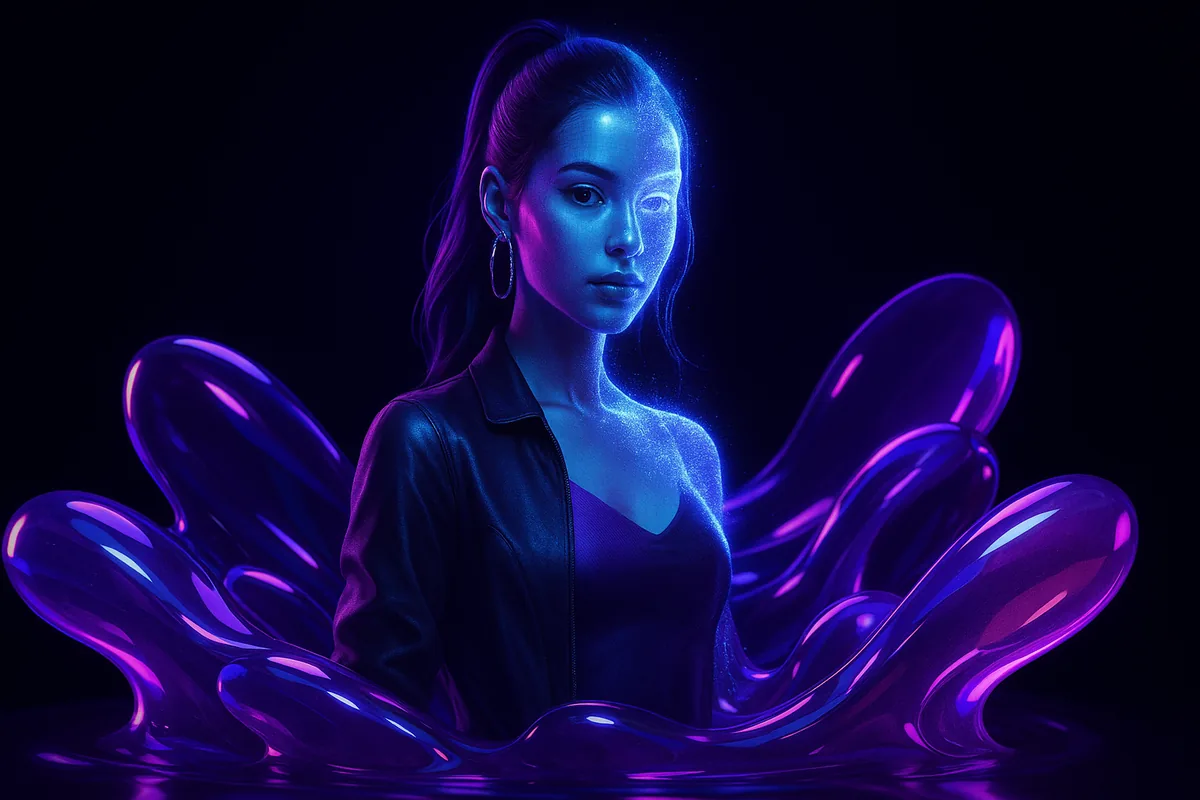
An AI influencer is a computer-generated social media persona, created and run with generative AI instead of a real person in front of a camera, that posts content, builds a following, and works with brands like any other creator.
The face, voice, and personality are designed once and then reproduced consistently across every photo, video, and caption. No studio, no travel, no camera crew. A single creator, or a small team, can run an AI influencer that posts daily, replies to comments, and lands brand deals, all without a human ever appearing on screen.
Key characteristics that define the category:
- Consistency. The same face and style show up in every post, on schedule, with no bad days.
- Full customization. Appearance, voice, personality, and message are all decided by the creator, not left to chance.
- Scale. One AI influencer can produce far more content per week than a single human creator managing a camera and a shooting schedule.
- Lower production cost. No studio time, no travel, no talent fee per shoot.
- Longevity. The persona does not age out of a niche or retire from the platform.
- Disclosure requirement. Because the persona is not a real person, most platforms and regulators expect a clear AI label on the account or the post.
Most AI influencers run like any other creator business: one niche (fitness, fashion, finance, lifestyle), one consistent voice, and a content calendar. What is different is the production method behind the camera, not the job itself.
The content itself looks like any other influencer feed: outfit posts, workout clips, travel photos, product reviews, daily thoughts. Followers scrolling past do not necessarily know they are looking at a generated persona unless the bio says so, which is exactly why the disclosure requirement below exists.
How AI Influencers Are Created
The five stages behind every persona
Building an AI influencer follows five stages, whether a solo creator does it in an afternoon or an agency spends weeks on it.
Stage 1: Concept and strategy. Define the niche, target audience, personality traits, and unique angle. Example: "Ava is an AI fitness coach obsessed with sustainable wellness, targets busy professionals aged 25 to 40, and delivers science-backed tips on TikTok."
Stage 2: Avatar design. Use an AI character generator (like RYLA) or hire designers. Options range from photorealistic avatars to stylized or cartoon-style characters. The identity, once set, needs to be reproducible in every future generation, not just the first image, which is the step most first-time creators underestimate.
Stage 3: Voice and tone. Train a text-to-speech model or hire a voice actor. Define speaking patterns, vocabulary, humor style, and communication preferences so replies and captions sound like one consistent person, not a different writer every day.
Stage 4: Content pillar definition. Build a library of recurring content formats (tips, stories, debates, before-and-after) so new posts stay on-brand without reinventing the format every time.
Stage 5: Platform integration and automation. Connect the persona to scheduling tools, set up auto-posting, hashtag generation, and analytics tracking so the pipeline runs without a manual upload for every post.
Concept to first post typically takes anywhere from an afternoon on a no-code generator to several weeks on a fully custom build. Modern platforms handle avatar generation, voice, and content optimization in one place, so creators spend their time on strategy and audience growth instead of production.
The step that separates a persona that works from one that does not is not any single stage above, it is whether the same face and style survive from the first generated image to the thousandth. A locked, reference-based identity is what makes an AI influencer read as one consistent person instead of a different face in every post.
Real AI Influencer Examples
Four named personas already earning real money
Lil Miquela (@lilmiquela). A photorealistic AI persona created by Brud in 2016, with more than 2.4 million Instagram followers. She has released music, appeared in campaigns for Calvin Klein and Prada, and her team is widely reported to charge five figures for a single sponsored post. Her success was the first proof that an AI persona could carry real commercial weight, not just novelty value.
Aitana Lopez (@fit_aitana). Created by the Barcelona agency The Clueless as a fitness and lifestyle persona, Aitana reportedly earns up to 10,000 euros in a strong month, though the agency has said a more typical month runs closer to 3,000 euros, split across brand partnerships with companies like Amazon, Razer, and Freepik, plus subscription content (Euronews).
Lu do Magalu (@magazineluiza). Originally a retail mascot for the Brazilian chain Magazine Luiza, Lu has grown into the highest-earning virtual influencer in the world, with 8 million Instagram followers and more than 31 million across all platforms. In 2024 she posted 74 sponsored collaborations and generated an estimated $2.5 million in income, roughly 34 times more than the next highest-earning virtual influencer that year (Inc.).
Noonoouri (@noonoouri). A stylized, doll-like AI character with around 860,000 followers, known for partnerships with Dior, Calvin Klein, and Louis Vuitton, monetized through sponsored posts and brand collaborations rather than a subscription model.
The pattern across all four: one narrow niche, one consistent look maintained across thousands of posts, and a posting cadence a human team could not sustain on the same budget.
The earnings spread between them is wide. Aitana Lopez's typical month (a few thousand euros) is a realistic mid-tier outcome; Lu do Magalu's $2.5 million year is closer to the ceiling of what a virtual persona backed by a major retail brand can pull in. Most creators building an AI influencer from scratch should expect a number much closer to Aitana's range than Lu's, at least in the first year.
Ready to Build Your AI Influencer?
Create your custom AI persona today and start growing your audience. No technical skills required.
Start Free TrialAre AI Influencers Real People?
No, and that is the whole point
No. An AI influencer's face, voice, and backstory are generated, not photographed. There is no human behind the avatar appearing on camera, though there is almost always a real creator, agency, or brand deciding what the persona says and posts.
That does not make the account fake in the way a bot or a stolen photo is fake. The persona is an original creative work, built on purpose, with a consistent identity maintained across every post. Followers who engage with an AI influencer are engaging with a designed character, similar to how audiences relate to an animated brand mascot or a game character, except this one posts daily, replies to comments, and takes brand deals.
The honest framing that most successful AI influencer accounts use in their bio: a clear statement that the persona is AI-generated, so followers know exactly what they are engaging with from the first visit to the profile.
AI Influencer vs Virtual Influencer vs CGI vs VTuber
Same idea, four overlapping labels
These four terms get used almost interchangeably, but they describe different production methods, and the difference matters if you are deciding how to build one.
| Term | How it is made | Typical use |
|---|---|---|
| AI influencer | Generative AI (image and video models) creates the persona and its content | Social media personas built for speed and volume, like the ones covered on this page |
| Virtual influencer | Umbrella term for any non-human influencer, regardless of how it is built | Includes AI influencers, CGI influencers, and everything below |
| CGI influencer | Hand-modeled and rendered in 3D software (Blender, Unreal Engine, Maya) | Lil Miquela and Noonoouri both started this way; slower and more expensive per new asset than generative AI |
| VTuber | A real human performer, motion-captured behind a 2D or 3D avatar in real time | Live streaming and gaming content, not a fully synthetic persona |
In practice, "virtual influencer" is the broad category and "AI influencer" is the fastest-growing method inside it. A CGI influencer needs a 3D artist for every new pose, outfit, or scene; an AI influencer generator produces a new, consistent image or clip in minutes at a fraction of the cost. A VTuber is the odd one out in this list: there is a real person driving the performance live, which functions closer to a digital costume than to a synthetic persona with its own generated identity.
The distinction matters beyond terminology. If a creator is comparing generator platforms, the relevant search term is "AI influencer" or "AI influencer generator." If the goal is a fully custom 3D character with a bespoke look, "CGI influencer" and a studio quote are the right search. Most of what gets built today, including every example on this page except the earliest CGI-era personas, falls under the AI influencer method.
How Do Brands Use AI Influencers?
Always-on content without the production overhead
Brands use AI influencers for the same reasons they use any influencer: reach and trust, plus three things a human creator cannot offer at the same cost: guaranteed on-brand behavior, unlimited content volume, and localization at scale.
Common use cases:
- Always-on product content. Daily posts, demos, and lifestyle shots without booking a new shoot for every campaign.
- Multi-market campaigns. The same persona adapted into different languages and cultural contexts without hiring a new face per market.
- Brand-safe spokespeople. No off-brand tweets, no scandal risk, no contract renegotiation mid-campaign.
- Rapid creative testing. Dozens of content variations produced quickly to see what resonates before committing a media budget.
- Product launches and limited drops. A consistent persona can front a launch across every channel on the same day, at once.
The tradeoff brands weigh is authenticity. A human creator's lived experience is difficult to fake; an AI persona wins on control and volume instead. For a full breakdown of campaign types, ROI measurement, and disclosure requirements for marketers, see AI influencer marketing.
Are AI Influencers Legal? Disclosure Rules Explained
Legal everywhere, with a disclosure requirement that is tightening
Yes, running an AI influencer is legal in essentially every major market. What is changing fast is the disclosure requirement around them.
In the United States, the FTC treats an AI-generated persona promoting a product the same as a human endorser: sponsored content needs a clear disclosure ("#ad" or "AI-generated"), and the creator or business behind the account is liable for false or misleading claims, not the persona itself.
In the EU, the AI Act requires that content be clearly labeled as AI-generated or AI-manipulated when it could mislead a reasonable viewer, which covers most AI influencer content by default. Individual platforms layer their own rules on top: Instagram, TikTok, and YouTube all have AI-content labeling requirements that apply whether or not a post is sponsored.
Practically, this means: state that the account is AI-generated in the bio, disclose sponsored content the same way a human creator would, and keep ownership of the underlying character clear (who owns the persona, the generated images, and the brand rights) before signing any brand deal.
Enforcement is already visible on the biggest platforms. Meta, TikTok, and YouTube have all rolled out AI-content labels that apply automatically to detected synthetic media, on top of whatever disclosure the creator adds manually. Treating disclosure as a brand-safety feature, not a legal chore, tends to convert better with brands who now expect it as a baseline.
How Do AI Influencers Make Money?
The same revenue mix as human creators, at a lower production cost
AI influencers monetize through the same channels as human creators: sponsored posts, affiliate marketing, digital products, subscriptions, and licensing. What changes is the economics behind each stream, since there is no shoot day, no travel, and no talent fee eating into the margin.
At the top end, Aitana Lopez reportedly earns up to 10,000 euros in a strong month, and Lu do Magalu generated an estimated $2.5 million in 2024 from 74 sponsored collaborations, an average of roughly $34,000 per post (Inc.). Most creators earn far less than these top accounts, especially in the first few months, and income scales with niche, engagement, and posting consistency more than with follower count alone.
For the full breakdown of all eight revenue streams, realistic income by follower count, and a 30-day monetization plan, see AI influencer monetization. For a closer look at what beginners should realistically expect in the first year, see AI influencer income.
Explore AI Influencer Success Stories
See how creators are earning $5K to $100K+ monthly with AI. Learn the strategies that work.
Start Free TrialAI vs Human Influencers: Quick Comparison
When each one wins
AI influencers win on: consistency (no missed posting days), cost per asset, scale (one persona, unlimited content variations), and zero scandal risk.
Human influencers win on: perceived authenticity, spontaneous cultural relevance, and the depth of relationship a real personal story can build with an audience over time.
Where the two meet: many brands now run hybrid strategies, human creators for storytelling and community, AI personas for high-volume, always-on content. For the full head-to-head on cost, engagement, and trust with data, see AI influencer vs real influencer.
The Future of AI Influencer Marketing
Where the category is headed
The virtual influencer market was valued at an estimated $6.06 billion in 2024 and is projected to reach $45.88 billion by 2030, a 40.8% compound annual growth rate (Grand View Research). That sits inside a broader influencer marketing industry worth roughly $33 billion in 2025 (Statista). Three trends are pulling that growth:
- Better generative models. Longer-form content, real-time replies, and more natural video are closing the gap with human creators.
- Regulatory clarity. As the EU AI Act and FTC disclosure rules mature, clear AI labeling becomes a trust signal instead of a liability.
- Licensing over hiring. More brands are licensing an existing AI persona instead of building one from scratch or booking a human influencer for every campaign.
The practical shift for creators: the tools to build a consistent AI persona keep getting more accessible, which means the advantage moves from who has access to generative AI, to who picks the sharpest niche and posts the most consistently.
None of this replaces the fundamentals. A well-defined niche, a consistent identity, and a real content pipeline still separate accounts that grow from accounts that stall, whether the persona in front of the camera is generated or not.
Sources
External data cited on this page
- Euronews - Meet the first Spanish AI model earning up to €10,000 a month
- Inc. - Why this AI influencer earns 40 times more than its human counterpart
- Grand View Research - Virtual Influencer Market Report
- Statista - Global influencer market size
Figures cited above were current as of publication; market-size and CAGR figures in particular move over time and should be re-verified against the source before quoting elsewhere.